Every year, businesses are urged to prioritise customer and worker safety over profit in the run-up to Christmas. We have eight fire safety tips to help.
Key takeaways
- Fire risks increase during the Christmas period due to decorations, extra electrical items, higher footfall and more waste, so workplaces need to be extra vigilant and carry out regular checks.
- Good housekeeping and clear escape routes are essential. Fire exits, doors and extinguishers must remain accessible at all times, and combustible materials should be stored safely away from heat sources.
- Staff awareness plays a critical role in fire safety. Employees (including temporary staff) should understand emergency procedures, evacuation routes and how to spot and report festive fire hazards.
Fire safety compliance breaches can be costly. It was only two years ago that the pipeline transportation company, Exolum Pipeline System Ltd, was fined £2.3m for exposing employees to a fire hazard.
The company's failure to identify and control the risks associated with conducting a pipeline repair breached sections 2 and 3 of the Health and Safety at Work Act 1974.
The government has stated that there are unlimited fines for those who breach fire safety regulations under the Fire Safety Order.
Workplace fire safety tips at Christmas
Staying safe has a lot to do with common sense. Following our tips will not only keep staff and customers out of danger but will also help you avoid hefty fines.
1. Increase fire wardens/marshal checks
Regularly check emergency exits as well as escape routes and promptly report any issues to the store or health and safety manager. Ensure there are regular fire drills to identify any fire safety issues that need to be addressed. Christmas is a busy time of year, which requires proactive engagement in marshal checks.
2. Step up good housekeeping practices
Waste packaging can cause congestion, trips, and falls. Ensure it is removed promptly for disposal and not allowed to build up in busy areas or along exit routes. During the festive season, there can be more waste packaging than usual, so this requires particular attention.
3. Always keep fire doors clear
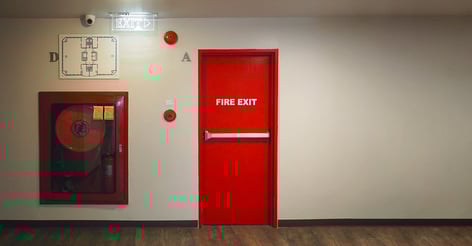
Avoid storing surplus stock or display equipment in front of any fire doors. These are emergency exits, and any obstruction hampers evacuation. In the event of a fire, every second counts.
4. Check clearances in any storage rooms
Don't stock items too high, and ensure that there is adequate clearance from lights or other heat sources to minimise the fire risk. And don't store stock directly under sprinkler systems, as this may reduce their effectiveness in the event of a fire.
5. Communicate emergency routes
Pay particular attention to training temporary or seasonal staff or anyone seconded from another store. All staff working during the festive season need to be aware of the emergency routes and assembly points. They may be unfamiliar with your store layout and the rules.
6. Monitor and manage overcrowding
Of course, all businesses want to see increased footfall in stores at Christmas. But be sensible and realistic. If customers cannot move around easily, they may not be able to evacuate safely either. In extreme situations, consider closing the doors temporarily to all new visitors to keep everyone safe.
7. Ensure fire extinguishers are visible
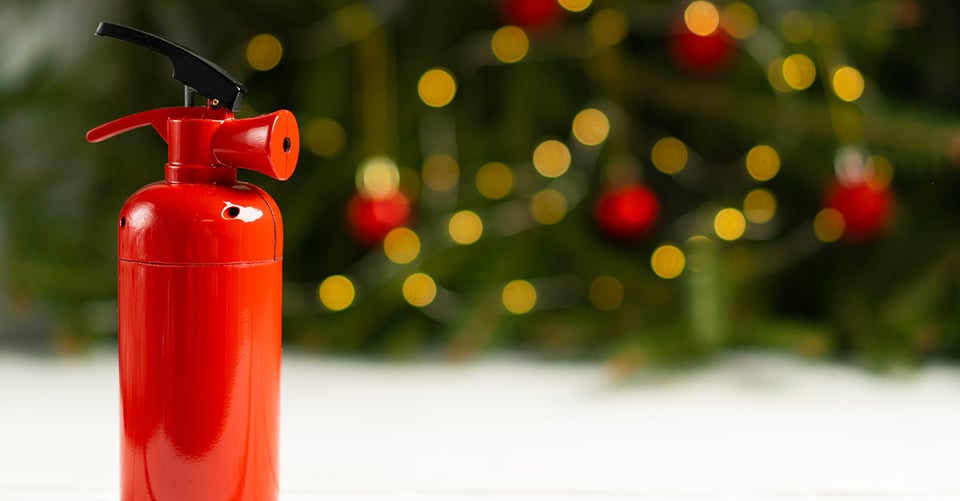
Any fire extinguishers attached to plasterboard walls could become loose, potentially detaching and causing injuries. It is vital to ensure that all fire extinguishers are clearly visible and securely fitted. Loose fire extinguishers should either be placed on a floor stand or refitted with a sturdy backboard.
8. Check all Christmas lights thoroughly
Decorative lights are an additional fire hazard not usually present at other times of the year. That's why it's crucial to get a qualified person to examine the wires for frayed cables and ensure all connections are intact.
Fire safety in the workplace FAQs
1. Who is responsible for fire safety in the workplace?
The employer or building owner is legally responsible for fire safety. They must carry out a fire risk assessment, put appropriate fire precautions in place, and ensure staff are informed and trained on fire procedures.
2. How often should a fire risk assessment be reviewed?
A fire risk assessment should be reviewed regularly and updated whenever there are significant changes, such as alterations to the building, new work processes, increased staff numbers, or after a fire-related incident.
3. What fire safety training must employees receive?
Employees must receive fire safety training when they start work and periodically afterwards. This includes understanding evacuation procedures, recognising fire hazards, knowing the location of exits and extinguishers, and what to do if a fire occurs.
More on fire safety compliance at Christmas
OurIIRSM-accredited e-learning in our Risk Management Training Package is designed to help you navigate the ever-changing regulatory landscape. The IIRSM approves quality content and integrates risk decision-making to help keep people and organisations safe, healthy and resilient. For training focused on health and safety, we also offer a Health and Safety Training Package that includes RoSPA-assured courses.
If you would like to access leading insights and compliance tips, you can browse our free resources by topic to find guides, modules, compliance bites and more.
Explore our collectionWritten by: Emmeline de Chazal
Emmeline is an experienced digital editor and content marketing manager. She has a demonstrated history of working in both the education management and software industries. Emmeline has a degree in business science, and her skillset includes Search Engine Optimisation (SEO), Answer Engine Optimisation (AEO) and digital marketing analytics. She is passionate about education and utilising her skills to encourage greater access to e-learning.

.webp?width=472&name=Types_of_PPE_1200x627%20(2).webp)